Security Monitor Pro Review

How We Chose the Best DIY Home Security Home security, your way Every home is different, and so is every homeowner’s security needs. Like most technical services, you can pay for professionals to craft your home security system or you can take matters into your own hands. DIY home security means you customize your device kit, self-install, and then monitor alerts from your sensors and video feed. Self-monitoring is the common difference between DIY and traditional security, but there are plenty of companies that strike a happy medium between both. We looked at providers offering pure DIY as well as those offering professional monitoring, either de facto or as an upgrade.
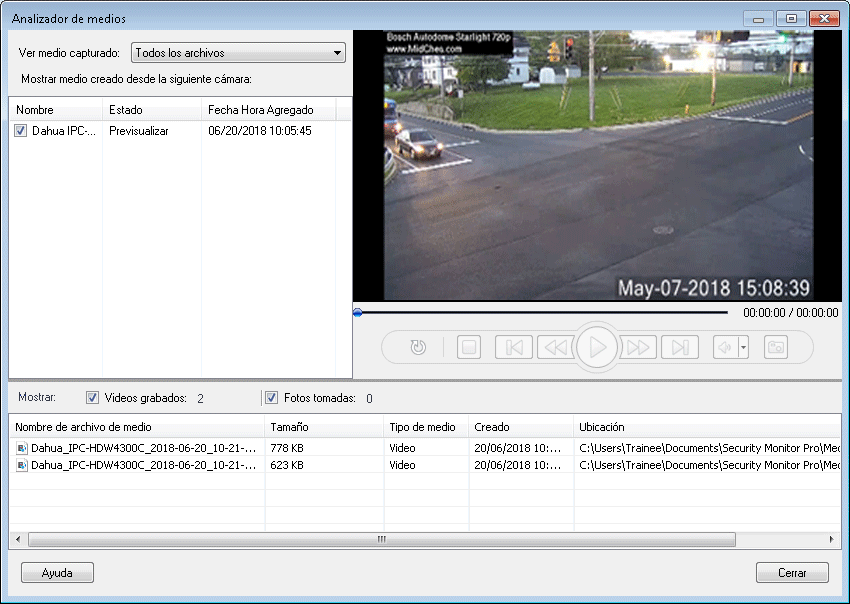
Deskshare Security Monitor Pro Review
Z-wave Support We required all systems to have Z-Wave Support — the most universal mesh network for communicating appliance to appliance. One of the biggest draws of a DIY system is the opportunity to add in third-party equipment (like or a ) at any point. Z-Wave is available in over from more than 700 companies. Plus, you have flexibility in where you place various devices because Z-Wave can communicate farther distances than other protocols — like Wi-Fi, for example — since it functions by sharing an Internet connection between devices as opposed to a localized router. Installation and function Ultimately, we wanted systems that could integrate seamlessly into our homes and improve our quality of life. To find which fit the bill, we spent a day outfitting a 1,900 square-foot home with the equipment of our finalists. We appraised the installation process, the ease and clarity of registering and syncing, the app experience, and functionality.
“application/octet-stream”), also known as a MIME, is type of Internet standard originally developed to allow the exchange of different types of data files through. Dec 20, 2017 - A MIME attachment with the content type 'application/octet-stream' is a binary file. Typically, it will be an application or a document that must be. Dec 10, 2018 - If a server doesn't recognize the.css suffix for CSS files, it may send them with text/plain or application/octet-stream MIME types. If so, they won't. Mime type application octet stream. Dec 11, 2013 - No. The content-type should be whatever it is known to be, if you know it. Application/octet-stream is defined as 'arbitrary binary data' in RFC.